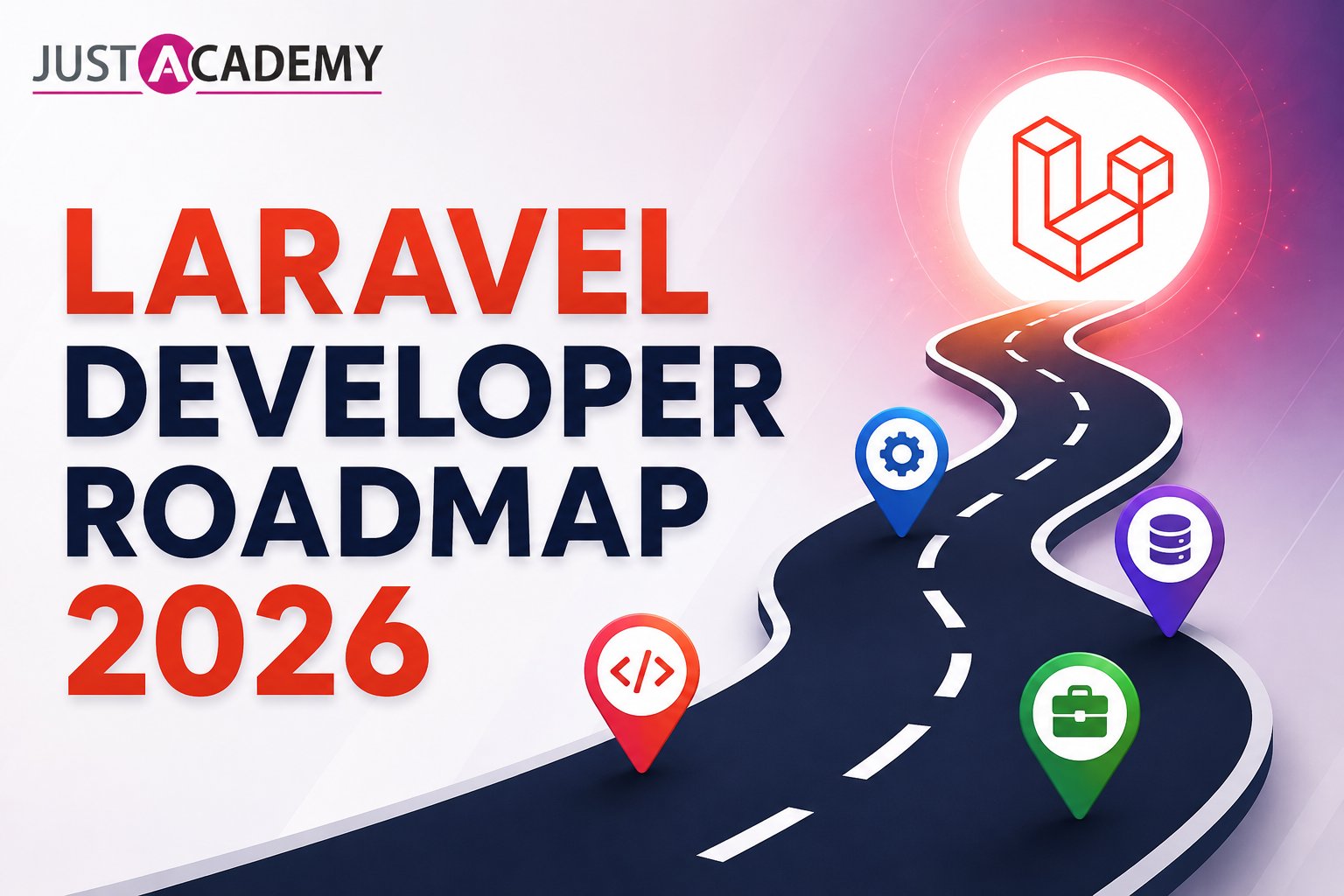
A practical, no fluff path to becoming a job ready Laravel developer this year, from your first "Hello World" route to your first offer letter.
Why Laravel Is Still One of the Smartest Backend Bets in 2026
If you have spent even a weekend scrolling through backend development subreddits or LinkedIn job posts, you have probably noticed something. Every few months, a new JavaScript framework claims it is going to make PHP obsolete. And yet, here we are in 2026, and Laravel is still one of the most requested skills in backend developer job listings across India and abroad. That is not an accident. It is a sign that laravel development has quietly become one of the most dependable, well paying, and genuinely enjoyable career paths in web development.
Laravel was never just another PHP framework. It was built to fix the pain points that developers complained about for years, messy routing, repetitive database queries, no clean structure, and security holes that kept popping up in raw PHP projects. Laravel changed that by giving developers a proper MVC architecture, an expressive syntax, and tools that just work out of the box. If you are someone exploring laravel courses or wondering whether learn laravel is still worth your time in 2026, the honest answer is yes, and this blog is going to walk you through exactly how to get there.
We are going to cover the entire roadmap here, the technical skills you need, the projects that actually get you hired, and the career paths open to a skilled laravel developer. Along the way, we will also talk about the frontend skills that pair beautifully with Laravel, because no backend developer today works in complete isolation from HTML, CSS, and JavaScript.
Whether you are a complete beginner, a php laravel developer looking to sharpen your skills, or a java backend developer curious about switching stacks, this roadmap is written for you.
Understanding What Laravel Actually Is Before You Start Coding
Before jumping into the technical roadmap, it helps to understand what Laravel really is and why it matters. Laravel is an open source PHP framework created by Taylor Otwell, designed around the principle that development should feel enjoyable and creative, not like a constant fight against boilerplate code. It follows the mvc architecture, which separates your application into three layers, the Model that handles data, the View that handles what the user sees, and the Controller that connects the two.
This separation matters more than beginners realize. When your code is organized this way, debugging becomes faster, teams can work on different parts of an application without stepping on each other, and scaling a project from a small business website to a large enterprise system becomes far less painful. This is one of the biggest reasons companies still prefer hiring developers with strong framework laravel knowledge over those who only know raw PHP.
Laravel has also matured significantly over the years. With laravel 10 and its successors bringing performance improvements, better testing tools, and cleaner syntax, the framework has stayed relevant in a way many expected it to fade out. If you are catching up in laravel 2026, you are not late, you are actually joining at a point where the framework is more stable and beginner friendly than it has ever been.
The Core Laravel Skills Roadmap: From Composer to Eloquent ORM
Let us get into the actual roadmap now. This is the part most people search for when they type "how do I become a laravel developer" into Google at midnight.
Step 1: Get Comfortable With PHP Fundamentals First
This might sound obvious, but skipping this step is the number one reason beginners struggle with Laravel later. You do not need to be a PHP expert, but you should be comfortable with variables, functions, arrays, loops, object oriented programming basics like classes and inheritance, and how PHP handles forms and sessions. Laravel is built on PHP, so trying to learn Laravel without this foundation is like trying to learn a dance routine without knowing how to walk steadily first.
A lot of beginners get impatient here because PHP fundamentals feel slow and unglamorous compared to jumping straight into a framework. Resist that urge. Spend a couple of weeks writing small standalone PHP scripts, a simple contact form, a basic calculator, a script that reads and writes to a text file. These exercises seem trivial, but they build the muscle memory you will lean on constantly once Laravel starts abstracting things away from you. When something eventually breaks in a Laravel project, and it will, your ability to debug it quickly almost always comes down to how well you understand what is actually happening underneath the framework's syntax sugar.
Step 2: Learn Composer, Laravel's Best Friend
Once your PHP basics are solid, the next stop is composer, the dependency manager that Laravel relies on completely. Composer is how you install Laravel itself, and it is how you pull in third party packages for things like payment gateways, PDF generation, or image processing later in your career. Spend a few hours just understanding how composer.json works, how to require packages, and how autoloading functions. This single skill will save you countless hours of confusion down the line.
Step 3: Master Laravel Routing and MVC Structure
This is where Laravel starts to feel like magic. You will learn how routes map to controllers, how controllers talk to models, and how views render the final output to the browser. Understanding this flow deeply is not optional. Every single laravel project you build for the rest of your career will follow this same rhythm, so take your time here rather than rushing to the flashy parts.
Step 4: Dive Deep Into Eloquent ORM
If there is one feature that makes developers fall in love with Laravel, it is eloquent orm. Instead of writing raw SQL queries every time you want to fetch, insert, update, or delete data, Eloquent lets you interact with your database using clean, readable PHP syntax. Learning relationships in Eloquent, one to many, many to many, and polymorphic relationships, will make you dramatically more efficient at handling real world data structures like blogs, ecommerce catalogs, or user management systems.
Alongside Eloquent, you need solid database management skills. This means understanding mysql deeply, writing efficient queries, designing normalized database schemas, and knowing when to use indexes. A lot of learners treat database knowledge as separate from Laravel, but honestly, your value as a backend developer is directly tied to how well you understand the data layer, not just the framework syntax.
Step 5: Learn CRUD Operations Inside Out
Every real application, no matter how complex it looks on the surface, is built on crud operations, create, read, update, and delete. Build small practice projects repeatedly until creating a form, validating input, storing it in the database, displaying it, editing it, and deleting it becomes second nature. This is the bread and butter work of daily development, and interviewers test this constantly because it reveals whether you actually understand the fundamentals or just memorized tutorials.
Step 6: Build and Consume REST APIs
Modern web and mobile applications rarely talk to the backend directly through server rendered pages anymore. Instead, they communicate through APIs. Learning rest api development in Laravel means understanding how to structure API routes, return proper JSON responses, handle authentication using tools like Laravel Sanctum or Passport, and manage API versioning. This skill alone opens doors to mobile app backend roles, which are in high demand right now.
Beyond the basics of returning JSON, a mature grasp of API development also means understanding rate limiting, proper error response formatting, request validation using Form Requests, and API resource classes that let you control exactly what data gets exposed to the outside world. These details might sound minor when you are practicing on your own, but they are exactly the kind of thing a senior developer will scrutinize during a code review, and exactly the kind of thing that separates a tutorial level understanding of Laravel from a ready for production one.
If you want to see how a full curriculum builds these skills step by step with live mentorship rather than piecing together scattered tutorials, it is worth looking at a structured Laravel training program that walks through routing, Eloquent, and API building in a guided sequence. And if you are still unsure whether this path fits you, most programs let you test the waters through a free demo class before committing.
Step 7: Version Control With Git and GitHub
No professional developer, junior or senior, works without version control. Learning git and github is not optional anymore. You need to understand commits, branches, merging, resolving conflicts, and pull requests. Beyond the technical skill, having an active github profile with your practice projects is often the first thing recruiters check before even calling you for an interview. It is your proof of work, more convincing than any certificate.
Frontend Skills Every Laravel Developer Should Still Know
Here is something a lot of backend focused learners underestimate. Even if your goal is purely backend work, understanding frontend basics makes you a dramatically more employable and effective developer. Laravel's Blade templating engine works hand in hand with frontend markup, so knowing how to structure and style that markup properly is part of the job.
Start with HTML training to understand semantic structure, then move into CSS training to learn how layouts, responsiveness, and visual design actually work. From there, JavaScript training becomes essential because Laravel applications frequently need dynamic, interactive elements, form validations, live search, or dashboard interactions that pure server side rendering cannot handle alone.
Once you are comfortable with these three, picking up Bootstrap training will help you build clean, responsive interfaces quickly without reinventing the wheel every time you start a new project. Many Laravel job postings today actually list basic frontend familiarity as a preferred skill, not just a nice to have, because businesses want developers who can handle a project end to end when needed, especially in smaller teams and startups.
If your long term goal is to become a well rounded full stack developer rather than staying purely backend, it is worth exploring a MERN stack developer bootcamp alongside your Laravel learning path, since understanding both PHP based and JavaScript based full stack ecosystems gives you far more flexibility in the job market.
Building Real Projects: The Fastest Way to Learn Laravel
Tutorials only get you so far. At some point, the fastest way to actually understand laravel software development is to build something real, break it, fix it, and build it again. Here are project ideas that consistently show up in strong developer portfolios, arranged roughly from beginner to advanced.
A personal blog application. This teaches you CRUD operations, authentication, and basic Eloquent relationships between users and posts. Keep it simple at first, then add categories, tags, and comments as you grow more confident.
A task management or to do application with user authentication. This introduces you to Laravel's built in authentication scaffolding, middleware, and route protection, concepts that appear in nearly every real world application you will ever build professionally.
An ecommerce style product catalog with cart functionality. This is where you start dealing with more complex relationships, orders connected to users, products connected to categories, and possibly integrating a payment gateway. It is also a great place to practice REST API development if you build a separate frontend that consumes your Laravel backend as an API.
A booking or appointment system. Think along the lines of a doctor appointment app or a hotel room booking system. These projects force you to deal with date and time logic, availability checks, and more advanced database relationships, which are exactly the kinds of problems you will face in real client work.
A REST API only backend for a mobile app. Skip the frontend entirely and build a pure API using Laravel, complete with token based authentication. This project alone demonstrates to recruiters that you understand how modern applications are actually architected today, with separate frontend and backend teams working through APIs.
A learning management or course platform with role based access. This is a slightly more ambitious project, but it is an excellent one for demonstrating range. You will need to build separate permission levels for admins, instructors, and students, handle file uploads for course materials, and manage enrollments as a many to many relationship between users and courses. Projects like this tend to stand out in a portfolio precisely because they show you can reason about real world business rules, not just technical syntax, which is exactly the kind of thinking hiring managers are trying to evaluate when they review your GitHub profile.
The key here is documentation. For every project, write a clear README on GitHub explaining what the project does, the technologies used, and any challenges you solved. This turns a simple coding exercise into a genuine talking point during interviews.
Common Mistakes Laravel Beginners Make and How to Avoid Them
Before moving further into career paths and salary trends, it is worth pausing on something most roadmaps skip entirely, the mistakes that quietly slow beginners down. Recognizing these early can save you months of frustration.
The first mistake is skipping the Artisan command line tool and doing everything manually. New learners sometimes create controllers, models, and migrations by hand, copying and pasting boilerplate code, without realizing that Laravel's Artisan CLI can generate all of this instantly with commands like php artisan make:model or php artisan make:controller. Learning Artisan early is not just a convenience, it is how professional Laravel developers actually work day to day, and showing up to a job without this habit makes you noticeably slower than your peers.
The second common mistake is writing all your logic directly inside controllers. This works fine for a small practice project, but as an application grows, bloated controllers become nearly impossible to maintain. Learning to move business logic into service classes, and keeping your database queries organized through Eloquent models or repository patterns, is a habit worth building early rather than unlearning later under pressure at your first job.
Another mistake, surprisingly common even among learners who have been studying for a few months, is ignoring validation and error handling until something breaks. Laravel makes form validation genuinely simple through Form Requests, yet many beginners skip this step entirely while building practice projects, assuming they will add it later. Later rarely comes, and the habit of writing unvalidated, unguarded code sticks. Build the discipline of validating every single form input and handling every possible failure case from your very first CRUD project onward.
Finally, many beginners treat documentation as a last resort instead of a first stop. The official Laravel documentation is genuinely one of the best written technical documentation resources in the entire web development world, clear, example driven, and constantly updated. Developers who build the habit of checking the docs first, rather than immediately searching for a random blog post or forum answer, tend to develop a much deeper and more accurate understanding of the framework over time.
Essential Tools in the Laravel Ecosystem You Should Know
Learning the core framework is only part of becoming a well rounded Laravel developer. The broader Laravel ecosystem includes several tools that professional teams rely on daily, and getting familiar with them early will make you noticeably more employable.
Laravel Telescope is a debugging assistant that gives you deep insight into requests, database queries, jobs, and exceptions happening inside your application during development. Instead of guessing why a query is slow or why a request is failing, Telescope shows you exactly what happened behind the scenes, which is invaluable once your applications grow beyond simple CRUD screens.
For testing, Laravel pairs naturally with PHPUnit, and writing basic feature and unit tests is a skill that separates hobbyist developers from professional ones. You do not need to become a testing expert overnight, but understanding how to write a simple test that checks whether a route returns the correct response, or whether a model relationship works as expected, demonstrates a level of maturity that interviewers notice immediately.
On the deployment side, tools like Laravel Forge and Laravel Vapor simplify the process of getting your application from your local machine onto a live server. Forge handles traditional server provisioning and deployment pipelines, while Vapor is built specifically for serverless deployment on AWS. You do not need to master these immediately as a beginner, but knowing they exist, and understanding roughly what problem each one solves, will help you sound informed rather than lost when these topics come up in interviews or on the job.
Queues and job scheduling are another area worth exploring once your fundamentals are solid. Real applications often need to send emails, process large files, or handle time consuming tasks without making the user wait. Laravel's built in queue system, paired with tools like Redis, lets you push these tasks into the background, and understanding this pattern is often what separates a developer who can build a demo project from one who can build something that survives real world traffic.
Laravel Career Paths: Choosing the Right Learning Environment
One question that comes up constantly among learners is whether to study Laravel through free online tutorials, self paced online courses, or structured mentor led training. There is no single right answer, it depends on your learning style, your timeline, and how much accountability you personally need. If you are weighing whether classroom sessions or online learning suits you better, especially if you are based in Mumbai, this comparison of Laravel online course vs offline course, which is better in Mumbai breaks down the practical differences in a way that can help you decide.
What matters most, regardless of format, is that your learning path includes real project work, code reviews from someone more experienced than you, and exposure to how professional development teams actually operate, using Git, working with tickets, following coding standards, and writing clean, maintainable code rather than just code that technically runs.
Career Opportunities and Salary Trends for Laravel Developers in 2026
Now let us talk about the part everyone is really curious about, what happens after you learn all this.
The demand for laravel jobs has remained remarkably steady, and in many markets, it has actually grown as more businesses realize that maintaining a fast, secure, well structured backend matters more than chasing the newest trendy framework. PHP still powers a massive percentage of the internet, and Laravel is the framework of choice for a large share of new PHP projects being built today.
Entry level php laravel developer roles typically involve working under senior developers, handling smaller features, bug fixes, and CRUD heavy modules while learning the codebase of larger applications. As you gain one to two years of experience and demonstrate strong php laravel developer skills, you naturally move into mid level roles where you own entire modules, mentor juniors, and start making architectural decisions.
For those with three or more years of solid experience, senior Laravel developer roles come with significantly higher pay, along with opportunities to move into technical lead or backend architect positions. Some developers also transition into laravel developer remote jobs, working for international companies or agencies, which has become increasingly common as remote hiring normalized across the tech industry.
Freelancing is another strong path. Businesses of every size need custom web applications, and a developer with strong laravel projects in their portfolio can build a steady freelance income building everything from small business websites to complex internal tools for enterprises. Some developers also specialize further, becoming consultants for a laravel web development company, helping agencies deliver client projects faster and more reliably.
Interestingly, professionals coming from other backgrounds also find their way into Laravel. It is not unusual to see a java backend developer pick up Laravel as a second stack because the underlying concepts of MVC architecture, REST APIs, and database management transfer surprisingly well between languages. If you already understand backend logic in one language, adding Laravel to your toolkit is far faster than starting from zero.
Across industries, Laravel developers are not limited to a narrow slice of the job market either. Ecommerce platforms, fintech products, healthcare booking systems, education platforms, and internal enterprise tools all rely heavily on Laravel because of how quickly a skilled team can ship secure, maintainable features with it. This spread across industries is a big part of why the demand has stayed consistent rather than being tied to the fate of one particular sector. A developer who understands both the technical side and how to communicate with non technical stakeholders, explaining timelines, trade offs, and scope in plain language, tends to move up faster than one who only focuses on writing code in isolation. That soft skill, often overlooked in technical roadmaps, ends up mattering just as much as your grasp of Eloquent relationships once you are a year or two into your career.
Choosing the Right Institute to Learn Laravel
If you have decided that structured training is the right path for you rather than piecing together scattered YouTube videos, choosing where to learn matters just as much as what you learn. Not every training program goes deep enough into real project work, API development, or database design, some stop at surface level syntax and leave you unprepared for actual interviews.
If you are trying to shortlist options, particularly if you are based in or around Mumbai, this breakdown of the top 10 Laravel training institutes in Mumbai, which one should you choose is a genuinely useful starting point, since it compares curriculum depth, project exposure, and placement support across different institutes rather than just listing names.
Why Structured Training Makes a Real Difference
There is a reason so many learners who start with free tutorials eventually enroll in a structured course. Learning in isolation, without feedback, without deadlines, and without anyone reviewing your code, often leads to gaps you do not even realize exist until an interviewer asks a question you cannot answer confidently.
JustAcademy, an ISO certified training institute with a strong presence across Mumbai and Pune, along with live interactive online courses available globally, has built its Laravel curriculum specifically around this gap. The focus is not just teaching syntax, but building real applications, understanding database design properly, and preparing learners for the kinds of questions and tasks they will actually face on the job.
The training combines live interactive sessions with hands on project work, meaning you are not just watching prerecorded videos and hoping you understood correctly. You get to ask questions in real time, get your code reviewed, and work alongside instructors who have actual industry experience building Laravel applications for real clients. Alongside the technical curriculum, placement support helps bridge the gap between finishing a course and actually landing your first Laravel developer role, something that pure self study rarely provides.
Whether you choose to attend classroom sessions at the Mumbai or Pune branch, or join through live interactive sessions from anywhere in the world, the goal remains the same, turning you from someone who has watched a few tutorials into someone who can confidently walk into an interview and talk through real projects you have built yourself.
Conclusion
Laravel in 2026 is not a framework you need to worry about becoming outdated anytime soon. If anything, it has become more refined, more widely adopted, and more central to how businesses build reliable web applications quickly. The roadmap is clear, start with solid PHP fundamentals, learn Composer and the MVC structure, get comfortable with Eloquent ORM and database management, build real CRUD based projects, learn REST API development, and do not neglect Git, GitHub, and basic frontend skills along the way.
What separates developers who get hired quickly from those who struggle is rarely raw talent. It is consistent, structured practice combined with real project work and honest feedback on that work. Whether you choose to learn independently or through a guided program, the most important step is simply starting, today, with your first line of Laravel code.
It is also worth remembering that this roadmap is not something you need to complete in a straight line or in a fixed number of weeks. Some learners move through PHP fundamentals and Composer in a matter of days and then spend a month getting comfortable with Eloquent relationships and REST API design. Others take the opposite approach. What matters far more than speed is whether each concept genuinely sticks before you move to the next one, because Laravel, like most frameworks, rewards depth over speed once you reach the interview stage. A developer who deeply understands five core concepts will almost always outperform one who has superficially skimmed twenty, simply because real interviews and real projects tend to probe for depth rather than breadth.
If you are ready to take this seriously and want a structured path with mentorship, live sessions, and real project work behind you, you can register for a free demo class to see how the training actually works before you commit, or download the brochure to explore the full curriculum at your own pace.
Why Laravel Is Still One of the Smartest Backend Bets in 2026
The Core Laravel Skills Roadmap: From Composer to Eloquent ORM
Building Real Projects: The Fastest Way to Learn Laravel
Career Opportunities and Salary Trends for Laravel Developers in 2026